
Introduction
Running out of floor space? Or maybe your old equipment is struggling with the heavier loads you’re taking on lately? We get it. Every day, we talk to factory managers who are stressed about one thing: safety vs. efficiency.
As an experienced overhead crane manufacturer, we know that buying a crane isn’t like buying a drill. It’s a massive investment that you’ll have to live with for the next 15–20 years. Pick the wrong one, and you’ve just bought yourself a very expensive bottleneck.
In this guide, I’m going to skip the fluff and give you 5 practical steps to finding a custom crane solution that fits your shop like a glove.
1. Don’t Just Look at the Weight—Understand Your Real Needs
Before you start hunting for the lowest price from an overhead crane manufacturer, stop and look at your floor. A “standard” crane is rarely the right answer for a serious operation.
A. Load Capacity: Think About Your Future Self
Don’t just buy for the heaviest thing you lift today.
-
The Smart Move: If you’re mostly lifting 5 tons but occasionally hit 8 tons, don’t push a 5-ton crane to its limit. Go for the 10-ton crane.
-
The Reality: It’s way better to have extra power in the bank than to hear your crane straining under a load. Overloading is the fastest way to kill your equipment.
B. Span & Height: Measure Twice, Build Once
You need the exact distance between your runway rails (the Span) and how high you actually need that hook to go.
-
The “Headroom” Trap: We see this all the time—someone buys a crane and realizes it’s going to hit the ceiling lights or the HVAC ducts. A solid overhead crane manufacturer will customize the girder to give you every inch of clearance possible.
C. Duty Class: The “Marathon” Factor
This is the one detail most people miss.
-
A3/A4: Think of this as a reliable backup—perfect for a maintenance shop where you use it a few times a day.
-
A5/A6: This is your workhorse. If you’re running a steel mill or a busy warehouse where that crane never stops moving, you need this.
-
The Bottom Line: Using an A3 crane for an A6 job is like running a marathon in flip-flops. You’re going to burn out the motor, and you’re going to do it fast.

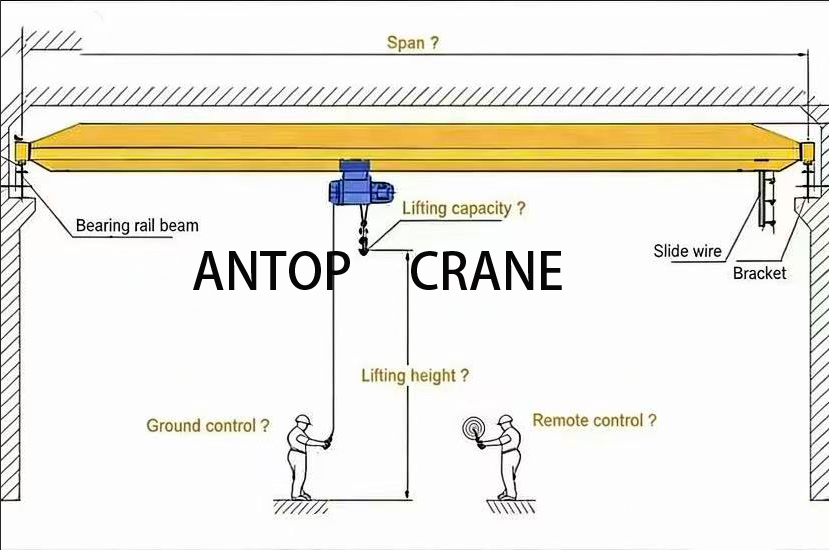
2. Single Girder vs. Double Girder: Which One Makes Sense?
It’s not just about which one looks stronger—it’s about your building’s DNA.
| Feature | Single Girder Crane (单梁) | Double Girder Crane (双梁) |
| Capacity | Usually up to 20 Tons | Up to 500+ Tons |
| Hook Height | Standard | Higher (Hook sits between girders) |
| Cost | More economical | Higher initial investment |
| Maintenance | Easier access | Requires professional platforms |
-
Top Running: If you need to move heavy loads and want maximum height.
-
Under Running: If your building is small and you need to hang the crane directly from the roof.
Check out the specs here: Our Overhead Crane Range
3. Safety Features: Don’t Settle for “Good Enough”
In this business, safety is your best ROI. If you’re talking to an overhead crane manufacturer and they aren’t bragging about these features, run:
-
Limit Switches: Because nobody wants a hook crashing into the drum.
-
Overload Protection: It’s like an insurance policy for your motor—it stops the lift if the load is too heavy.
-
Emergency Stops: Big, red, and easy to hit. You hope you never need them, but they have to be there.
-
The Paperwork: Make sure they carry CE, ISO, or OSHA stamps. It’s the only way to know the steel won’t fail when you’re mid-lift.
4. Customization: Why “Standard” Is Often a Bad Deal
Let’s be real: Most “standard” cranes expect you to change your factory to fit the machine. That’s backwards. As a custom crane solution provider, we think the crane should fit your factory.
👉 Case in Point: Our Bangladesh Project
We recently worked with a client in Bangladesh who had a nightmare scenario: crazy high humidity and almost zero ceiling clearance.
-
The Fix: We didn’t give them something off the shelf. We used specialized anti-corrosion coatings for the motor and built a low-headroom girder that hugged the ceiling.
-
The Result: They got 25% more storage space without having to spend a dime on building a bigger warehouse.
💡 The “After-Sales” Reality Check
Buying the crane is just Day 1. You need a partner who answers the phone on Day 500. Ask your overhead crane manufacturer:
-
Installation: Can you send a pro or guide us via video?
-
Parts: How fast can I get a replacement if a sensor goes down?
-
Support: Are you there if my night shift has a problem at 2 AM?
Conclusion: You’re Buying Peace of Mind, Not Just Steel
At the end of the day, you want to go home at night knowing your crew is safe and your production is moving. A cheap crane is a great deal until it breaks down in the middle of your busiest month.
Not sure which specs you actually need? Let’s hop on a call and figure it out together.